ONAIR / Start Here
Can you daily drive on air?
Yes - with a proper driving setup, sensible clearance and an ownership routine you understand.
Air suspension can work on a daily-driven car when the components, installation and maintenance suit that use. The goal is a repeatable driving position with travel and clearance, not driving everywhere at the lowest setting.

Use a checked driving height, not a parked display position.
Confirm actual clearance when passengers or cargo change.
Manage moisture and investigate new pressure loss or cycling.
01 / THE DETAILS
Give the car a real driving position.
Have the installed suspension checked for wheel clearance, usable travel and alignment at the height you use on normal roads. A lower parked position is a separate use of the system, not the default for driving.
On the road
Clearance, steering travel, alignment and suspension movement need to work together.
When parked
Use an approved display position only with the vehicle stationary and clear of obstacles.
02 / THE DETAILS
Treat presets as a starting point.
A pressure preset recalls a target pressure. It does not measure the distance between the car and the ground. Extra passengers, luggage or a changed setup can alter the resulting height.
Confirm the actual position before moving. Do not assume a setting saved on an empty car is suitable after loading it. For the control choices, read 2V versus 4V.
03 / THE DETAILS
Make the small checks familiar.
- Confirm a normal driving height before setting off.
- Know how the compressor normally sounds and cycles.
- Inspect tank and trap drains using the equipment instructions.
- Look for new rubbing, leaks, damaged lines or loose mounts.
- Keep the component list and service information available.
The aim is to notice a change early. Use the maintenance routine to organise your checks.
04 / THE DETAILS
Plan for the weather you actually drive in.
Cold-weather ownership adds attention to moisture, drainage, equipment temperature limits and road clearance. A heated water trap does not guarantee that every part of the system is protected from freezing.
Start with the Canadian winter guide. Suitable tires and sensible driving remain essential; changing suspension height does not replace either.
05 / THE DETAILS
Know the difference between an adjustment and a fault.
Occasionally changing height is normal operation. Repeatedly compensating for an unexplained drop is not a repair. Record the symptom and have the cause checked.
Arrange repair or recovery. Never inspect underneath a vehicle supported only by air pressure or a hydraulic jack.
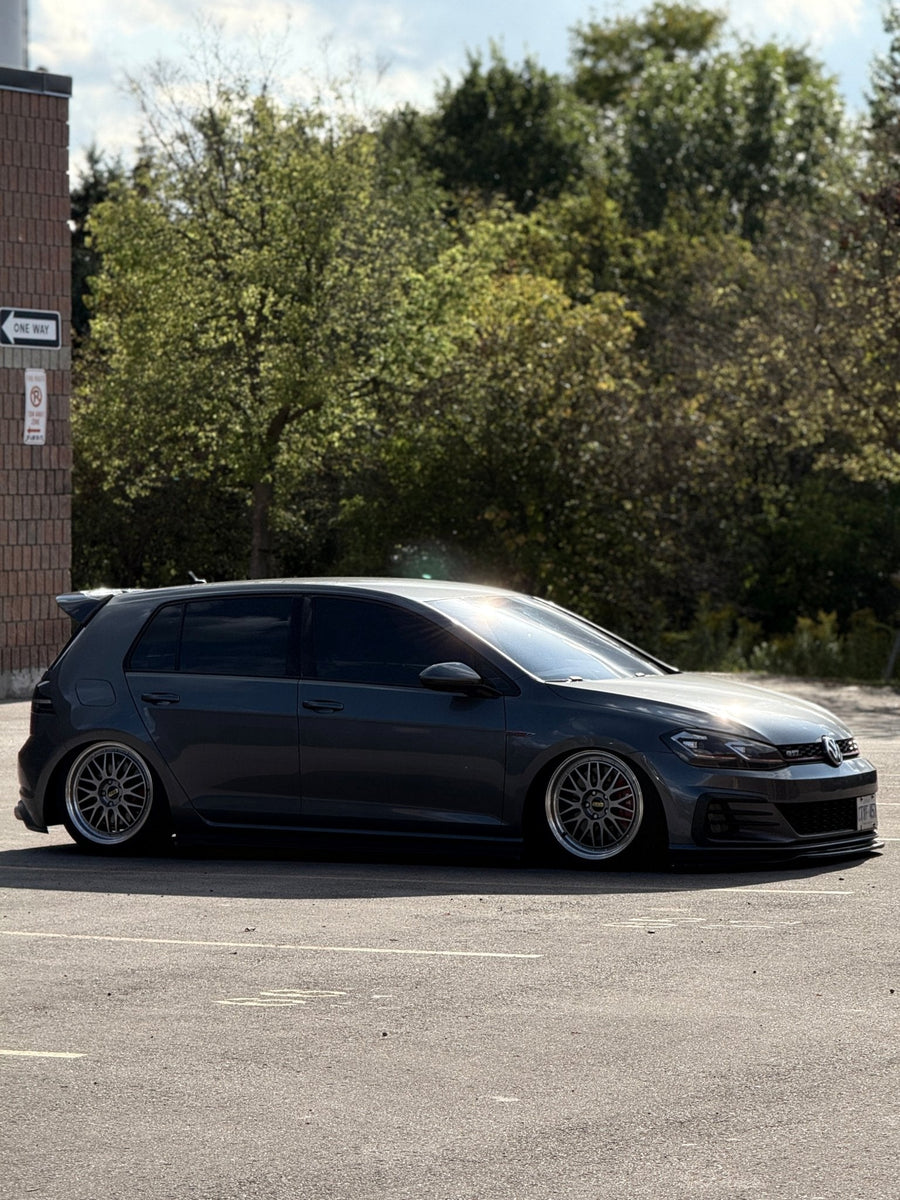
For a closer look at a documented daily-oriented build, explore George's Mk7.5 GTI.
ONE MORE THING
The questions that come next.
Will air ride automatically be more comfortable than stock?
No. Spring behaviour, damping, tires, available travel and setup all affect the ride. Height flexibility is not a universal comfort guarantee.
Can I keep using the same preset after changing wheels?
Recheck clearance, travel and the normal driving setup. Different wheel and tire dimensions can change what is safe.
Do I need a large show-style trunk setup?
No. A suitable installation can be compact or hidden, provided it retains secure mounting, cooling and access for maintenance.
Sources & equipment references
General education is not a replacement for the instructions supplied with your exact components. Product-specific ratings and procedures do not transfer automatically to another setup.
- ONAIR 2V pressure-preset guidance
Pressure targets and changing loads.
- ONAIR Performance Air Suspension
Vehicle-specific suspension and manual damping features.